
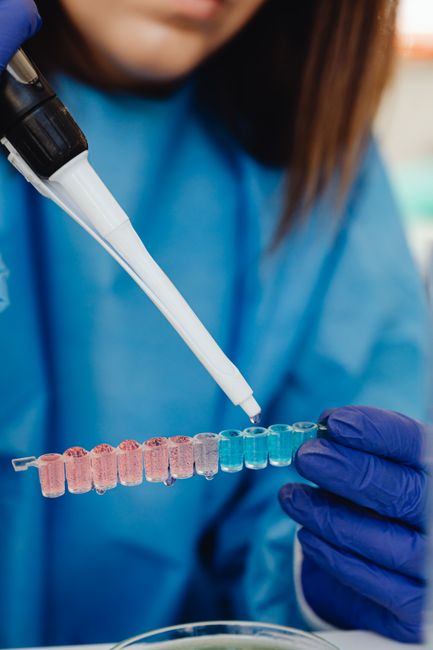
You Spend Hours a Day Holding the Wrong Tool
If you’re a wet lab scientist, you hold a pipette for 4-8 hours daily. A bad one causes hand fatigue, finger pain, and over months or years, repetitive strain injury (RSI) that can force you out of the lab altogether — the same RSI risk that shows up at the computer, where our ergonomic mouse guide for scientists covers the desk-side half of the problem. Yet many labs buy pipettes based on what was in the cart 15 years ago, not what your hands actually need.
The good news: there are only a handful of major manual pipette brands, and each has clear strengths and weaknesses. Understanding the tradeoffs takes the guesswork out of choosing. Whether you’re outfitting a new lab, replacing a worn set, or just tired of your current pipettes, this guide will help you make a decision you won’t regret.
I’ll compare the three brands that dominate wet labs in 2026: Rainin, Eppendorf, and Gilson. I’ll be honest about cost, comfort, accuracy, and when each makes sense.
What Actually Matters When Choosing a Pipette
Ergonomics and comfort. This is not a luxury. Poor ergonomics directly cause RSI, tendonitis, and carpal tunnel syndrome. Your pipette should require minimal finger force, have a balanced weight distribution, and fit your hand size naturally. If it doesn’t feel right in the first five minutes, it won’t feel right after five years.
Accuracy and precision specifications. Most modern pipettes meet acceptable accuracy standards for routine work, but some are tighter than others. Know what your application demands. Single-channel immunoassays may tolerate CV (coefficient of variation) of 2-3%, but qPCR reactions might require better than 1%.
Tip compatibility. Different pipettes use different tip formats. Universal tips fit most modern pipettes, but some branded tips (Rainin LiteTouch, Eppendorf epT.I.P.S.) integrate with specific pipettes for better fit and accuracy. Check what tips your lab already stocks before committing to a brand.
Warranty and calibration support. Pipettes drift out of calibration. How easy is it to get calibration service? How long is the warranty? Some manufacturers offer 3-year warranties with free calibration; others are shorter or charge per recalibration.
Cost. Manual pipettes range from $300 to $600 per unit. A single-channel set (0.5-10 µL, 10-100 µL, 100-1000 µL, 1000-5000 µL) totals $1500-2500. Multi-channel pipettes (12-channel, 96-channel) cost more but save time in high-throughput work. Budget accordingly.
Availability and ecosystem. Can you buy replacement parts easily? Are tips widely available, or will you be locked into proprietary options? Are there local service centers, or will you ship pipettes cross-country for repair?
Quick Comparison Table
| Feature | Rainin | Eppendorf | Gilson |
|---|---|---|---|
| Cost per unit | $400-600 | $350-500 | $300-450 |
| Accuracy (CV %) | <1% | <1% | 1-2% |
| Ergonomics rating | Excellent | Very good | Good |
| Tip ecosystem | Proprietary (LiteTouch) | Universal + proprietary | Universal |
| Learning curve | Minimal | Minimal | Minimal |
| Warranty | 3 years + free calibration | 3 years | 2 years |
| Best for | High-volume labs, precision | Mixed labs, balance | Budget-conscious, reliability |
Rainin Pipet-Lite XLS+: The Gold Standard
Rainin (owned by Mettler-Toledo) produces the Pipet-Lite XLS+ series, which is widely considered the best manual pipette on the market. It dominates biotech labs and research institutions.
Why Rainin excels:
- Exceptional ergonomics. The XLS+ has a distinctive curved design that fits naturally in your hand and minimizes finger fatigue. After eight hours of pipetting, your hand feels fine. This is not hyperbole; it’s why researchers who use Rainin stay loyal.
- Outstanding accuracy and precision. Rainin pipettes consistently deliver CV better than 1% across the range. If your application demands tight accuracy, Rainin rarely disappoints.
- LiteTouch technology: Rainin’s branded tips integrate perfectly with the pipette for reproducible fit and minimal tip-to-pipette variation. The cost premium for LiteTouch tips is offset by the reduced variability they provide.
- Excellent warranty and support. 3-year warranty with free calibration included. Rainin service is responsive.
- Robust build quality. Rainin pipettes are engineered to last. Many labs report 8-10 years of daily use before needing replacement or major service.
- Strong liquid-handling integrations. Many automated liquid handlers (Tecan, Hamilton) are compatible with Rainin pipettes, useful if you integrate manual and automated work.
Where Rainin falls short:
- Price is the biggest barrier. A single-channel set runs $1800-2400, more than alternatives. For a 10-person lab, you’re looking at $20,000+.
- Tip dependency. While universal tips work, LiteTouch tips are optimized for Rainin and cost more per tip than generic alternatives. This compounds the cost over time.
- Overkill for simple applications. If you’re doing bulk buffer additions or transfers where accuracy is not critical, you’re paying for precision you don’t need.
Who should buy: High-throughput biotech labs, qPCR or next-gen sequencing facilities, clinical or pharmaceutical labs where accuracy is non-negotiable, any lab where ergonomics will prevent RSI in senior staff.
Amazon link: Rainin Pipet-Lite XLS+ Single-Channel Pipette Set
Eppendorf Research Plus: The Balanced Choice
Eppendorf is a household name in molecular biology. Their Research Plus series occupies the middle ground: excellent quality, reasonable cost, and widespread availability.
Why Eppendorf is popular:
- Solid accuracy and precision. CV typically under 1.2%, very acceptable for most wet lab applications. Not quite Rainin’s consistency, but close enough for most use cases.
- Good ergonomics. The Research Plus has a balanced weight and moderate resistance. It’s comfortable for 8-hour days, though not quite as refined as Rainin’s curved design.
- Universal tips and proprietary options. Eppendorf’s epT.I.P.S. branded tips offer optimized integration, but universal tips work fine. This flexibility keeps costs lower.
- Strong ecosystem. Eppendorf integrates well with many automated platforms and is the de facto standard in many academic labs. Service and support are excellent.
- Competitive pricing. A single-channel set runs $1400-1800, a real saving versus Rainin.
- Excellent availability. Every major supplier stocks Eppendorf. Replacement parts and service are easy to find.
- Warranty: 3-year warranty with free calibration.
Where Eppendorf is less ideal:
- Ergonomics are good but not exceptional. Rainin still has the edge in comfort for heavy users.
- If you’re doing 96-channel multi-channel work at high throughput, Rainin’s design integration might marginally reduce fatigue.
- Tip cost can creep up if you rely on epT.I.P.S. proprietary tips.
Who should buy: Academic labs looking for quality without bleeding money, mixed labs doing both routine transfers and precision work, core facilities that serve diverse users, anyone already embedded in the Eppendorf ecosystem.
Amazon link: Eppendorf Research Plus Single-Channel Pipette
Gilson PIPETMAN Classic: The Workhorse
Gilson is the classic. PIPETMAN pipettes have been ubiquitous in wet labs for 40+ years. Many senior scientists learned on them.
Why Gilson persists:
- Lowest cost of the three brands. A single-channel set runs $1000-1600. For labs on tight budgets, this is a major advantage.
- Rock-solid reliability. Gilson pipettes are mechanically simple and nearly indestructible. They don’t fail often and are easy to repair.
- Universal tip compatibility across the board. No proprietary tip ecosystem means maximum flexibility and lowest tip cost.
- Universally available and widely serviced. Every university and research hospital has Gilson repair experience.
- Familiar interface. If your senior staff trained on Gilson, there’s no learning curve. New postdocs will feel immediately at home.
- Decent accuracy. CV of 1-2% is acceptable for most applications, though not competitive with Rainin for high-precision work.
Where Gilson lags:
- Ergonomics are functional but dated. The cylindrical design is comfortable but not optimized for eight-hour comfort. RSI risk is higher than with Rainin or Eppendorf.
- Accuracy, while acceptable, is the weakest of the three. If your application demands better than 1.5% CV, Gilson may not be the best choice.
- No forward-looking features. Gilson PIPETMAN design has barely changed in decades. That’s stability and familiarity, but also a sign that innovation has moved elsewhere.
Who should buy: Budget-conscious academic labs, core facilities that need robustness over performance, labs with senior staff trained on Gilson, researchers doing routine transfers where precision is not critical, high-volume multi-channel work where ergonomics matter less than throughput.
Amazon link: Gilson PIPETMAN Classic Single-Channel Pipette
Head-to-Head: Accuracy and Precision
All three brands meet ISO 8655 accuracy standards. But real-world precision (CV) differs:
- Rainin Pipet-Lite XLS+: <0.8% CV across range. Exceptional consistency.
- Eppendorf Research Plus: 0.8-1.2% CV. Very good, suitable for most applications.
- Gilson PIPETMAN: 1-2% CV. Acceptable but notably higher variation.
For routine pipetting (buffer transfers, sample prep), the difference is irrelevant. For qPCR, titration experiments, or sensitive assays, Rainin’s precision justifies the cost.
Head-to-Head: Ergonomics
This is where labs differ most based on actual use:
Best for high-volume single-channel work: Rainin. The curved design and balanced weight reduce hand fatigue dramatically. After 1000+ pipetting operations daily, your hands will thank you.
Best for mixed work (single and multi-channel): Eppendorf. The Research Plus is versatile and comfortable for varied tasks.
Best for low-volume or occasional use: Gilson. If you’re pipetting 50-100 times daily, the design difference is minimal. Cost is the deciding factor.
RSI prevention: Rainin > Eppendorf > Gilson. If hand pain or tendonitis is a concern in your lab, invest in Rainin.
Head-to-Head: Cost (per-unit, single-channel)
| Model | Single Unit | Set (4 pipettes) | Per-use cost (assuming 5-year life, 500k transfers/unit) |
|---|---|---|---|
| Rainin Pipet-Lite XLS+ | $500 | $1900 | $0.38/1000 transfers |
| Eppendorf Research Plus | $400 | $1500 | $0.30/1000 transfers |
| Gilson PIPETMAN | $300 | $1100 | $0.22/1000 transfers |
By total cost of ownership (including tips, calibration, and lifespan), Rainin is the most expensive but also the most durable. Gilson is cheapest upfront but may need replacement sooner. Eppendorf is the best value for labs that want quality without premium cost.
Who Should Choose Each
Rainin if:
- Your lab does qPCR, RNA/DNA work, or any precision liquid handling where accuracy matters
- Ergonomics and RSI prevention are priorities
- Your budget supports the premium (or your institution has a capital budget for it)
- You can leverage LiteTouch tips for optimized performance
Eppendorf if:
- You want a balance of quality, cost, and ecosystem integration
- Your lab does mixed work (routine transfers and precision assays)
- You’re already embedded in Eppendorf equipment (centrifuges, PCR machines, etc.)
- You need universal tip compatibility without proprietary lock-in
Gilson if:
- Budget is the primary constraint
- You’re doing routine, non-precision work (buffer additions, sample transfers)
- Your lab has existing Gilson equipment or institutional preference
- Reliability and simplicity matter more than cutting-edge features
Honorable Mention: Sartorius Picus Electronic Pipette
If your lab does high-volume work and budget allows, consider the Sartorius Picus electronic pipette. It combines accuracy (better than manual), ergonomics (motorized dispensing reduces hand strain), and programmability for repeated volumes. Cost is higher ($600-800 per unit), but for labs doing 1000+ dispenses daily, the time and comfort savings justify it.
Bottom Line
Choose based on your actual needs, not marketing or tradition:
- If you do precision work and ergonomics matter: Rainin is worth the cost.
- If you want balanced quality and reasonable pricing: Eppendorf is the safe choice.
- If budget is tight and precision is not critical: Gilson is reliable and affordable.
Don’t stay with a pipette you dislike out of institutional inertia. Your hands spend more time on pipettes than most other lab tools. Invest in equipment that fits your work and prevents injury — the same logic applies to documenting the work these pipettes go into; see our comparison of the best lab notebooks for scientists if that’s next on your equipment list. You’ll use it for years, and the comfort benefit compounds daily.
Before you buy, test-drive each brand if possible. Many suppliers have demo units. Spend 10 minutes pipetting with each. Your hands will tell you which one belongs in your lab.